Friends, Farmers Markets and Dancing Crow Wine
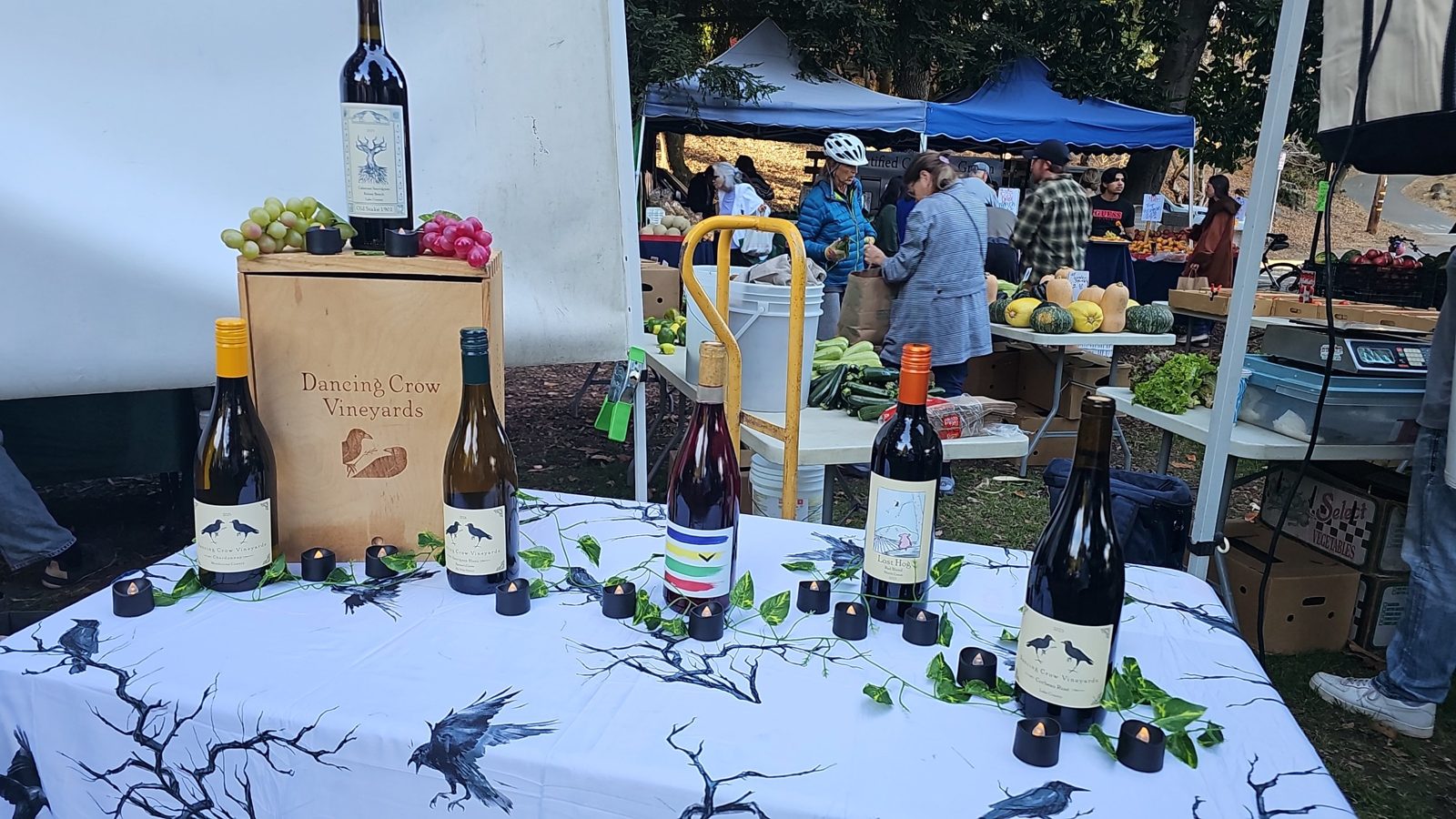
I’ve always enjoyed the unexpected conversations that happen around a bottle of wine. At the farmers market, they happen almost every Saturday.
Someone stops at the booth, curious about a bottle. Someone else tells me they don’t really drink white wine, or that they’ve never found a Chardonnay they like. I pour a little, tell them where it comes from, and before long we’re talking about food, travel, family, or somewhere we’ve both been. Sometimes people arrive with a shopping list and leave having made a new friend.
It’s one of my favorite things about selling wine. Nobody comes to a farmers market expecting to make a new connection. There’s no networking, no awkward introduction, no particular reason to talk to the person standing next to you. There’s simply a glass of wine and a little time.
Perhaps that’s one reason wine has been part of social life for so many centuries. The Greeks built their symposiums around it. Persian poets like Hafez and Khayyam found in the shared cup a language for friendship, love and the fleeting beauty of being alive. In France, wine belongs to the table as naturally as conversation belongs to dinner. Different cultures, different centuries, but much the same instinct: open a bottle, bring people together, and see what happens.
I’ve watched that happen at our little booth more times than I can count. And a lot of those conversations have started with Dancing Crow.
A family winery with a story
Dancing Crow is a family winery. They grow their grapes in Lake County, on ancient volcanic soil, and make their wines at their own winery in Hopland, Mendocino County. They are both the farmers and the winemakers, and the wines reflect the vision of Scott Kirkpatrick.
The style is French-inspired: dry, lighter in body, balanced, and made with minimal intervention. The idea is to keep as little as possible between the grape and the glass.
Even the name has a story. When the team first planted the vineyard, they laid out straw to mark the rows and went away for lunch. When they returned, a murder of crows had carried the straw away to build their nests. Instead of getting angry, they laughed and took it as a sign. Embrace the unpredictable.
I like that story. It says something about the personality of the winery, and perhaps about wine itself. Farming is never entirely predictable, and neither are the best things that happen around a table.
At the farmers market, I often meet people who arrive convinced they know exactly what they like. Someone only drinks Cabernet. Someone else has given up on Chardonnay altogether. I ask what they enjoy eating, what they’ve liked at a recent dinner, and then pour something they might not ordinarily choose.
The surprise is usually the best part. Someone who swore off Chardonnay goes quiet after a sip. Someone who only drinks Cabernet asks to try the Pinot again. Ten minutes later we’re talking about their children, their last trip or a restaurant they love.
Some come back every week. Some have become friends.
The wines
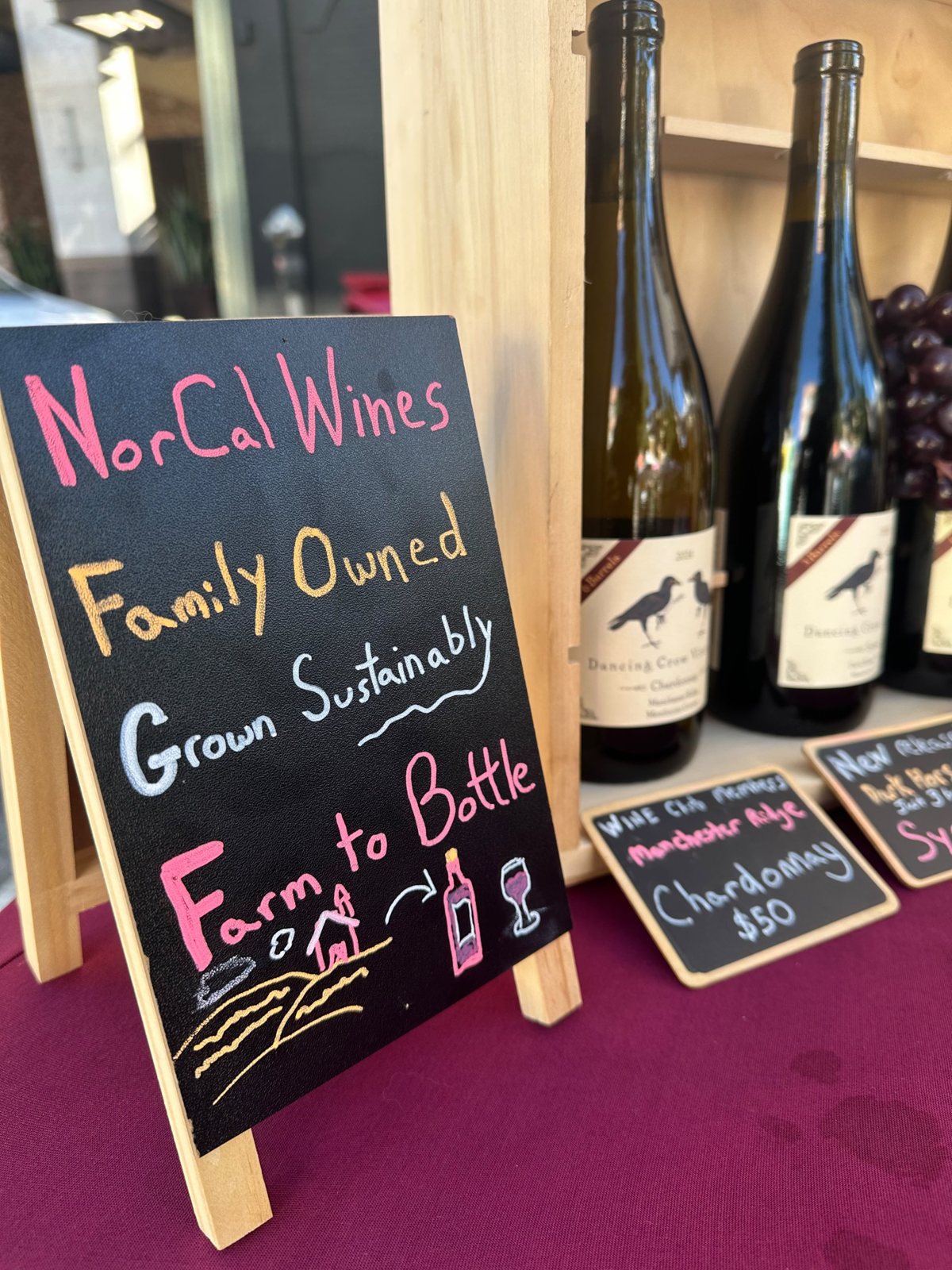
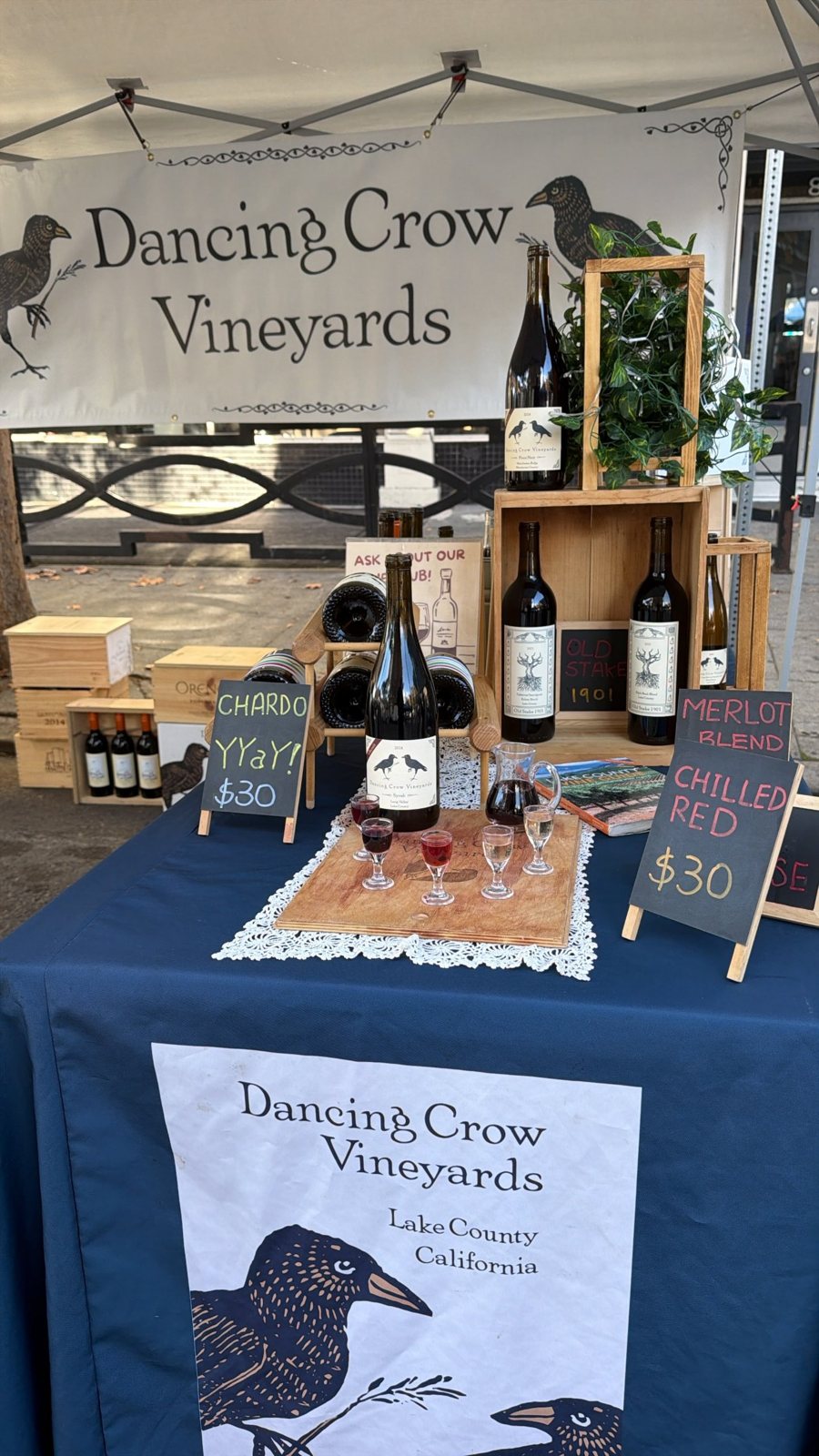
One of the pleasures of working with Dancing Crow is that there is always something interesting to introduce. These are not wines that all taste alike or follow a single formula. Each has its own personality, and Scott seems particularly interested in letting the grape and the place speak for themselves.
Farmer’s Cuvée Sauvignon Blanc
This is the bottle that converts people. Made exclusively for the farmers markets, it’s a Loire-style Sauvignon Blanc that Scott Kirkpatrick blends each year from his best Sauvignon Blanc lots. Every vintage is its own snapshot of the harvest.
It spends about six months in a large cask before finishing in tank. To me, it’s crisp and wildly floral, with grapefruit and mandarin, lime zest and a little bitterness that wakes up your whole mouth. The finish is clean, almost water-like, and makes you want another sip.
There’s a reason Lake County does this grape so well. Summer days can reach the 90s while nights drop into the 40s. That dramatic temperature swing allows the grapes to develop ripe fruit during the day while retaining their acidity overnight. Sauvignon Blanc thrives on that tension.
The French have Sancerre, New Zealand has Marlborough, and after a summer of pouring this wine, I think Lake County deserves a place in that conversation.
Pour it with Dungeness crab, ceviche, a goat cheese salad, or almost anything green from the stall next door.
Unoaked Chardonnay
Scott likes to say that Chardonnay tells you more about the winemaker than almost any other grape. On its own, it’s a relatively quiet variety: a little citrus, apple and pear. Everything else is a decision.
This one is fermented and aged in stainless steel, with no oak and no malolactic fermentation, using grapes from 30-year-old vines in one of the coldest spots the family farms.
You taste the grape, not the butter and not the barrel.
It’s Chardonnay in the style of Chablis, with green apple, a hint of pear, stony minerality and a light silkiness from time spent on its lees. For anyone who grew up drinking big, buttery California Chardonnay, this can be a revelation. It shows what the grape can be when nothing is covering it up.
Lovely slightly chilled with roast chicken, seafood pasta or anything you’d normally squeeze a little lemon over.
Rosé
Scott’s rosé is made from Pinot Noir in the dry, crisp style of Provence. It’s probably the most farmers-market wine on the table.
Hibiscus and strawberry on the nose, followed by lemon, pomegranate and citrus on the palate, with bright acidity and a long floral finish. Scott says a good rosé should make you lean forward into life, not lean back. I think that’s a rather good description of this one.
It’s also wonderfully easy to pair. Tomatoes, soft cheeses, grilled shrimp, a picnic in the sun: it goes with almost anything you can buy within fifty feet of the booth. It isn’t sweet like some rosés, and it’s light enough for a long afternoon with friends.
Old Stake Cabernet Sauvignon
Old Stake is the historic heart of Dancing Crow. The vineyard sits on Lake County’s Kelsey Bench and was first planted in 1901, making it about 125 years old.
The soil is deep red volcanic iron that stains your hands when you touch it. The vines send their roots down as far as sixteen feet in search of water. That struggle produces tiny, concentrated berries and wines with real structure.
The Cabernet is blended with about a quarter Merlot and picked in several passes to capture different levels of ripeness.
It has the backbone you’d expect from a Cabernet, with dark plum, black cherry and ripe fig, followed by a savory herbal finish. But it’s lighter on its feet than many California Cabs. Firm on the outside, soft in the middle. The Merlot rounds out the mid-palate while the Cabernet carries the finish.
It loves prime rib, lamb and hard cheeses, and will reward a few years in the cellar.
Old Stake 1901 Field Blend
If Old Stake is the heart of the winery, the Field Blend is its memory.
A field blend is the old way of making wine: different grape varieties planted side by side and harvested together, just as farmers did a century ago.
The original seven acres of head-pruned, freestanding vines at Old Stake contain more than a dozen varieties, including Zinfandel, Grenache, Cinsault, Alicante Bouschet, Touriga Nacional and Cabernet Sauvignon, with a few white grapes mixed in.
You can’t simply replant a vineyard like this, and you can’t manufacture what 125-year-old vines bring to the glass. It’s a genuine rarity, made in small quantities, and layered in a way that no single grape could be: dark berries, plum, spice and a deep, earthy calm.
Whenever it’s available, I buy myself a bottle, even though it’s a splurge. It’s a wine for a special dinner and the people you want to share it with.
Lost Hog White and Lost Hog Red
The Lost Hog wines exist only for the farmers markets, made entirely from the family’s own estate fruit. The white is pure joy: white flowers, ripe orchard fruit, fresh and floral. When it sells out, I miss it, and so do our regulars. The name comes from a favorite piece of trivia: pigs, like crows, are among the smartest animals on earth, and a pig can remember where it found food for years. The Lost Hog is about always finding your way back home.
The Lost Hog Red is about 70 percent Merlot and 30 percent Cabernet Sauvignon, and it is the perfect casual dinner wine. Think chocolate-covered cherries: black cherry and milk chocolate, a touch of mole on the finish, silky but never heavy. It has presence without weight, like the quiet person at the table who everyone listens to when they finally speak. Duck, mushrooms, a weeknight pasta, or a square of chocolate after dinner.
Syrah
Dancing Crow’s Syrah is tiny in production, sometimes just a few barrels, with single-vineyard bottlings from vineyards like Don Fiora and Dark Horse. Syrah can be anything from a light red to the biggest, meatiest wine on the shelf, and like most of what Scott makes, his lives in the middle. It is aged in old, neutral barrels, so the oak adds texture but no flavor.
On the nose it seems like it is going to be a brute: blackberry, black olive, star anise and sandalwood. Then you taste it, and it is elegant, deep and complex, with rich, dark flavor and none of the heaviness. Scott calls it the ultimate red meat wine, even more than Cabernet, and unlike a Cab it is wonderful with pork. Anything off the grill.
Dark Horse Ranch Petite Sirah
Petite Sirah is the grape Scott built his career on, and it is usually made into something dense and syrupy. His idea was to pick earlier and handle it with a lighter touch, the way you would a Pinot Noir, and let its elegance show. His Petite Sirah comes from Dark Horse Ranch, a biodynamically farmed vineyard at about 1,800 feet above Ukiah, where old head-trained vines stand on their own looking out over the whole valley.
The result walks the line between powerful and pretty: blueberry, blackberry and black plum, lifted by delicate aromas of lilac, iris and sweet pea, with enough tannin to age for years. The 2023 earned 92 points and nearly sold out to the wine club. It is a perfect example of the depth and complexity a Syrah-family grape can have when someone lets it speak.
Corbeau Rusé
My all-time favorite. Corbeau Rusé means “mischievous crow” in French, a wink at those crows that stole the straw. It is a Southern Rhône-style blend, mostly Grenache with Syrah and a touch of Viognier and Zinfandel, and the grapes are hand-picked at night by headlamp, around 2 AM, when the fruit is cold and holds its freshness instead of turning jammy.
It is juicy and silky: red and black fruit tart, plum, rose petals and spice, then blueberry and black cherry, with an earthy, allspice finish. It is fantastic with aged cheese and cured meats, and if you are planning a holiday dinner, this is the bottle. Lake County and the south of France are strikingly alike, hot days, cool nights and all, and with your eyes closed this could be a village in the Rhône.
Chill Red
Yes, you chill it. The current Chill Red is almost entirely Pinot Noir from the same mountain vineyard as Scott’s Pinot Noir, with about half the grapes fermented as whole clusters. That gives it juicy, carbonic fruit at just 12 percent alcohol, lighter than the Sauvignon Blanc. Scott keeps the Pinot Noir name off the label on purpose: what he did to the grapes says more than the grape itself.
Cherries steeped in black tea, light and refreshing, with just enough grip that it never tastes like candy. Scott calls it a two-fist-bump wine, the wine version of an Aperol spritz: a little bitterness that makes you hungry for dinner. It is what I bring when someone says “bring whatever”: BBQ, pizza, a picnic, or the porch on a warm evening. For white-wine drinkers, it is the perfect gateway into red.
Mendocino Ridge Pinot Noir
This is the crown jewel. The fruit comes from Mariah Vineyards at 2,400 feet on the Mendocino Ridge, above the fog line in what locals call the “Islands in the Sky,” so high you can see the ocean from the vines. The vineyard is certified regenerative and farmed biodynamically, a standard that goes beyond organic: what comes out of the land goes back in, and the soil gets healthier every year. In the cellar, Scott does almost nothing: native fermentation, neutral barrels, nothing added.
On the nose: red cherry, fresh roses, wildflowers and wet earth after rain, with an earthy, almost forest-floor depth that I can only describe as the mountain itself coming through. On the palate it is like early-season cherries dropped into a cup of black tea, light and lively, with a soft tannin that holds the finish. It is more Burgundy than California, and it is the wine that stops the room. Duck, salmon, mushroom risotto, or someone you are trying to impress.
Scott makes wine the way a poet writes: every bottle feels like a short poem about the place it came from.
Why go all the way to Hopland
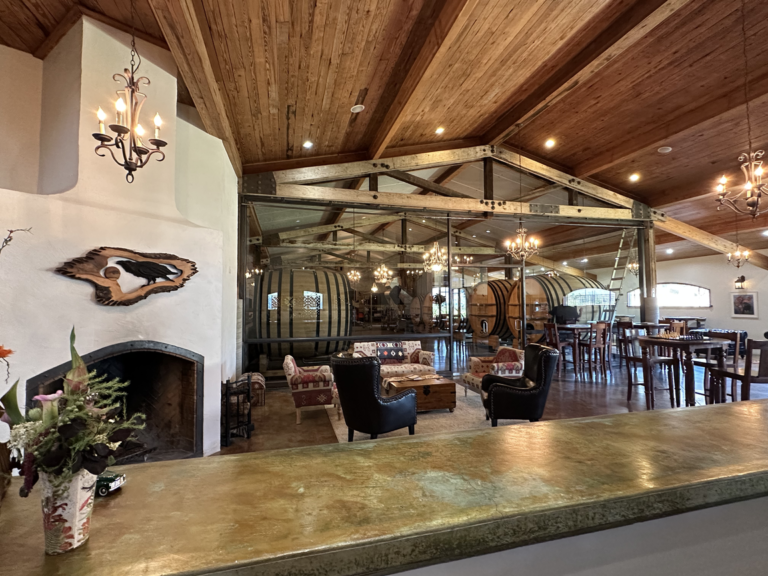
That’s what I want to share: not just the wine, but the whole slow day around it. The drive up 101 into Mendocino is part of it. Then a quiet family vineyard with only a few other people around, nowhere to rush to, and time to taste, walk the vines and sit in the courtyard with new friends. Wine country the way it used to be.
If that sounds like your kind of Saturday, come with us. Our next small-group wine day is Saturday, January 16: oculartravels.com/jan16. And if you see me at the Dancing Crow booth, stop by for a taste. You might leave with a new favorite bottle, and maybe a new friend.
Sources
- Dancing Crow Vineyards, Field Rep Master Training Guide (2026 edition): wine details, blends and Scott Kirkpatrick’s notes.
- Dancing Crow Vineyards, Q&A with Scott Kirkpatrick (April 2026): minimal-intervention winemaking and the market-only Lost Hog wines.
- Scott Kirkpatrick, “View from the Crow’s Nest: The Winding Road Home” (Dancing Crow wine club newsletter, July 2026): the Dark Horse Ranch Petite Sirah.
- Historic Vineyard Society, Old Stake 1901 Vineyard: planting date, acreage and grape varieties.
- dancingcrow.com